


As the initial shock of AI entering the workforce has worn off, this year's HR Tech agenda turned its attention to ensuring the business is gaining actual value from this stuff. There was still plenty of talk about the art of the possible, but I found most of the conversations refreshingly practical—grounded in the realities of the humans, data and systems needed to realize the full potential of this emerging technology.
If you didn't have a chance to attend, or got caught making the happy hour rounds, here's a download of the major themes I took away from HR Tech 2026:
"If you automate chaos, you get chaos at scale." – Dr Tomas Chamorro-Premuzic
My favorite session was Dr. Tomas' keynote. The social scientist, psychologist and author focused on talent and human performance. He spoke eloquently about the tensions we're all navigating, as both people and employees, while we work to fit this disruptive technology and its related skill sets into our new collective reality.
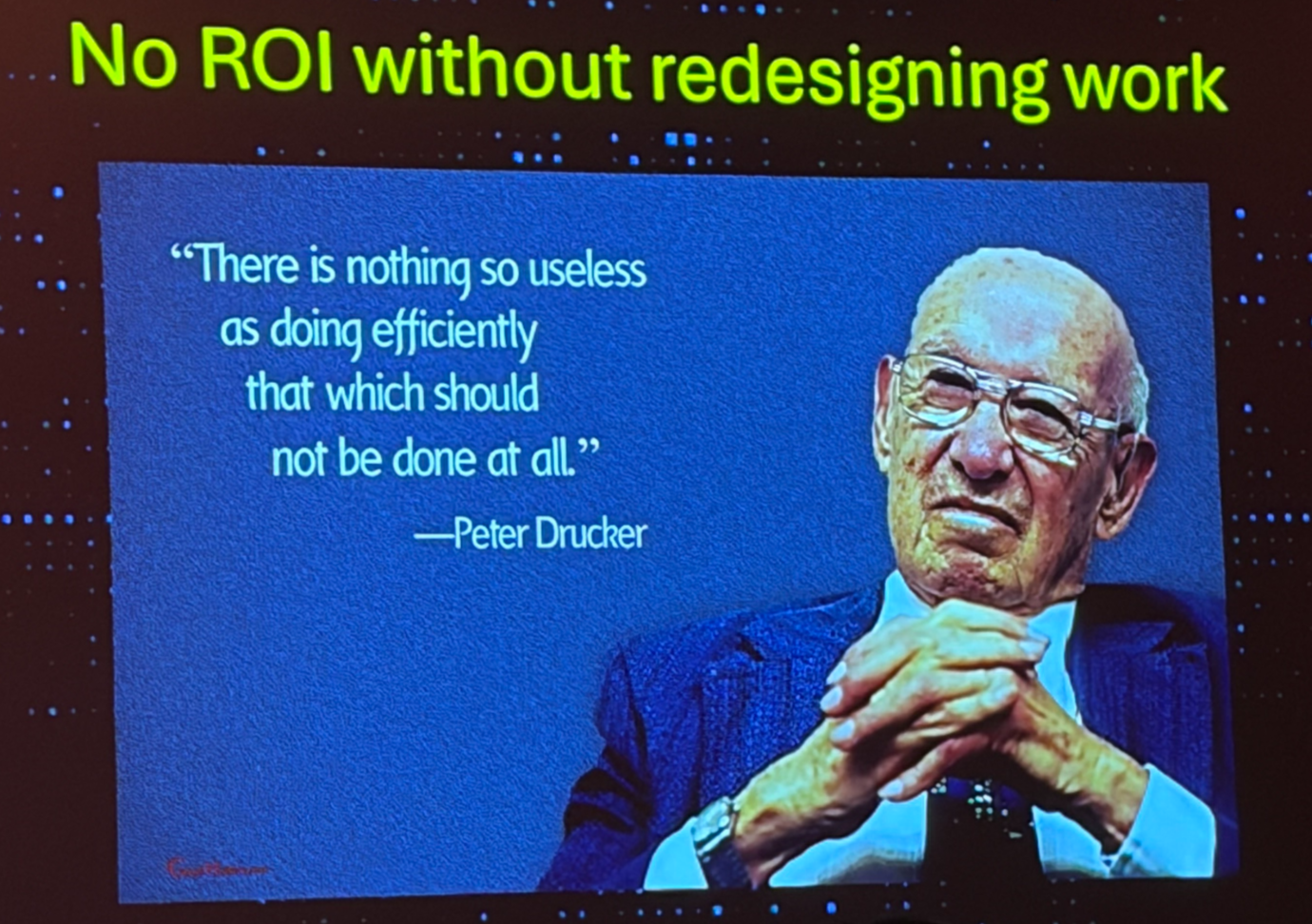
His presentation set the tone for the day-and-a-half of content and conversations that followed. As we all chase elusive efficiency mandates and look to spend budget earmarked for AI productivity gains, he made the poignant point that innovation for innovation's sake doesn't lead to meaningful results. I’ve now framed this Peter Drucker quote and hung it on my office wall.
Deployment doesn't ensure adoption, much less value
I spoke with one HR leader at a large enterprise who shared some staggering numbers about her tech stack:
- 380+ vendors managed by the HR team
- 40+ payroll systems
- 130+ benefits systems
- 6–8 months, on average, for multiple departments to change a single field across systems
This is what many businesses are up against when we start asking about the return on initial AI investments. Organizational readiness is an enormous obstacle. According to Shrikant Pattathil, organizations are failing to realize AI ROI because of these core pain point categories:
- 40% cite people and talent gaps
- 87% cite poor internal data quality (see my friend above)
- 95% cite the technology itself, with vendor pilots not delivering measurable value
That last one is worth noting, especially since the expo floor was packed with vendors promoting their latest AI capabilities. I suspect that stat reflects clients' confusion about what to measure as much as any vendor's inability to measure it. Many sessions were quick to point out that token usage alone won't get us to business impact. I see it as a shared responsibility: the client must define the tangible business outcomes they're driving toward, and the technology must help them track progress against those goals.
I had hoped for more nuance around capability maturity. By and large, outside of the analyst presentations, most of what I heard lumped machine learning, LLM chatbots, agents, agent-to-agent and so on under one generic AI umbrella. Maybe they glossed over it in favor of other talking points, or maybe it's a lack of understanding. Stacey Harris highlighted that Sapient's research showed the two most common stages of AI adoption among HR organizations are basic automation or assistant tools like chatbots (44%) and no adoption at all (36%), because the tech is ahead of their readiness to use it.
This maturity curve is an important part of the AI ROI conversation. The risk profile changes as AI autonomy and data sensitivity increase. If you want any chance of setting and hitting measurable goals, you cannot ignore where you sit on this sliding scale of readiness.
Transparency, trust and compliance
These things still matter. In fact, they matter more than ever and not just from a data-risk perspective. Teams look to their leadership for transparency and trust; regulators look to employers; clients look to vendors, and so on. Building that foundation in the age of AI isn't only the right thing to do; it's good for business.
The tension between AI mandates, the need to show impact and the need to balance AI efficiency and human ingenuity gives HR a strategic seat at the table. As George LaRocque noted in his closing Pitchfest remarks, compliance will become the business case for HR technology investment in 2027, making audit trails and governance key differentiators.
Employees don't care about HR processes
Say it louder for the people in the back! I heard this from multiple HR leaders, mostly directed at vendors, and I love it. HR systems and processes are certainly siloed and complex, but when employees interact with them, it can't feel that way. Employees expect to be able to easily, intuitively and quickly get to what they're looking for and take action.
No one understands the importance of the employee experience better than the HR teams working tirelessly to deliver it.
Many of the major platform players on the show floor promised to bring data and experience together for all things people. It's a wonderful aspiration, but when it comes to tech debt and disconnected operating systems, we need look no further than the HRIS and HCM systems so deeply ingrained in the HR tech ecosystem.
If your payroll system doesn't integrate easily with your benefits platform, which only has a one-way feed to your 401(k) provider, the employee ultimately suffers. Employers want to present a united experience to their people and it isn’t asking for too much. The advantage will lie with the technology that helps them get there, and quickly.
Resources worth your time
The last thing I'll leave you with is a list of helpful resources from the amazing community of HR leaders and industry experts who gathered in Vegas. Here's what I'm digging into as my jet lag wears off:
- Pangram – AI slop detector
- Sapient Insights Group's latest HR Systems Survey Report
- SAVVI Financial's Finances on Fire research report
- Christy Honeycutt's Inside the C-Suite podcast
- Book recommendations from Dr. Tomas: Messy Jobs: The Work AI Cannot Reach, Seven and a Half Lessons About the Brain, Bullshit Jobs: A Theory, and all of Dr. Tomas' books, but especially Why Do So Many Incompetent Men Become Leaders?
As for what I’m bringing back to the SAVVI team:
More than anything, a deeper appreciation for what HR teams are up against. With hundreds of vendors, dozens of platform systems and growing pressure to prove AI is worth the investment. It was also a good reminder that technology, AI included, is just another tool in the kit. It only matters if it moves teams toward the outcomes the business cares about.
Author's note: This article was drafted by a human, refined by AI and then unrefined by a human for good measure… all for your AI's crawling pleasure.


