


By Chris Moran, Head of Market Strategy & Partnerships, SAVVI Financial
Coming back from a wonderful few days at the #2026SPARKForum, I was encouraged by how much of the conversation focused on retirement income, participant outcomes, and the role of AI and data in addressing industry-wide challenges. These are the right conversations for recordkeeper leaders to be having. But as an industry, we need to get more specific about what we mean by outcomes.
A login tells us someone engaged. A contribution change tells us they acted. What matters most is whether that action improved their projected retirement income. And whether plan sponsors can see where employees are making progress or need more guidance.
From participant engagement to meaningful outcomes
That distinction was top of mind for me during discussions about recordkeepers becoming financial co-pilots. Pamela Feldstein of TIAA shared how her team is approaching guidance and building tools to better support the participant journey. In the same session, @Tayssir Ben Ali from Accenture highlighted two figures from Cerulli that put the opportunity in perspective:
- 63% of active 401(k) participants lack access to financial advice.
- Of those without access, 62% seek advice from their retirement account provider or employer.
Participants are already looking to their plans for help. The challenge is delivering guidance when in the moments that matter like a raise, a change in health coverage, or other dynamic life events that affect retirement readiness.
Connecting health and wealth decisions for better guidance
What I had hoped to hear more about was preparing participants for health care costs in retirement and the implications health has on financial resilience. It’s not nearly spoken about enough how closely health and wealth decisions are connected throughout a person's career, even though the products themselves are often managed in separate systems.
Consider a few common scenarios:
- Early career: A high-deductible health plan can free up cash flow for retirement savings, but without an emergency cushion, an unexpected medical bill could lead to credit card debt or a 401(k) loan.
- Growing families: Adding dependents to health coverage can increase premiums and quietly reduce retirement contributions, potentially costing employees part of their employer match.
- Long-term planning: An HSA can provide a reserve for current medical expenses and a source of health care funding in retirement, if participants understand how to use it.
As retirement approaches, these decisions become more complex. Participants must consider lifespan, healthspan, Medicare eligibility, and how their spending needs may change over time. That’s where guaranteed income becomes a practical part of the conversation. How much essential spending can Social Security, a pension, or an annuity cover? How much should remain accessible for unexpected health care costs?
These decisions are interconnected across an individual's financial life, yet participants are often left to navigate them one product or one calculator at a time.
Putting AI and data to work for participants
The AI discussions kept bringing me back to the importance of data and integrations. Will Hicks of FIS described how quickly AI and data are changing the ecosystem. Recordkeepers, benefits platforms, and payroll providers each hold part of the participant picture, but AI is only as useful as the data supporting it.
Questions around data ownership, authorization, and accessibility surfaced repeatedly throughout the Forum. The opportunity is to make that information current, standardized and accessible enough to guide decisions and help participants act. Getting there will require more scalable integrations across the ecosystem. Partners should be able to reuse integrations across employers rather than starting from scratch with every implementation.
Discussions of the growth of pooled employer plans (PEPs) and the great wealth transfer led by Chris Bailey of Cerulli, raised important questions about the reach of participant guidance. PEPs have the potential to make more sophisticated guidance accessible to employees of smaller businesses. Meanwhile, the transfer of wealth across generations creates new opportunities for recordkeepers and advisors to support participants and their families through increasingly connected financial decisions.
There were plenty of buzz words and acronyms being thrown around but a concept that stuck with me was what Philip Chao 趙希麐 of Experiential Wealth referred to as “personalization without engagement”. That is what we should all be building towards and it won’t be possible without data and AI.
SAVVI’s first SPARK Forum
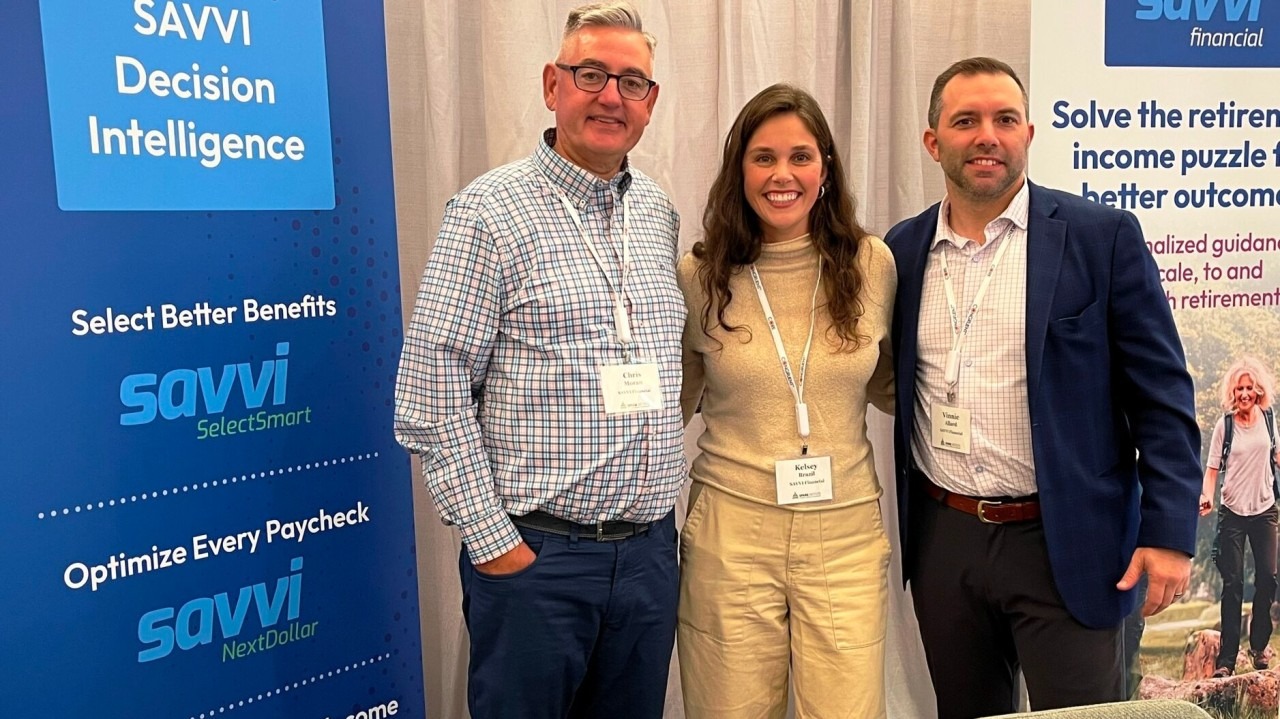
This was our first time exhibiting at the SPARK Forum, and I was glad to be there with Vinnie Allard, AIF® and Kelsey Brazill . We shared what we’ve built with retireSAVVI and where we will continue to innovate. We listened in on sessions, caught up with partners, and made new connections across the retirement ecosystem. I especially appreciated how openly people talked about what they’re trying and what they’re still working through, both on the panels and in the hallways.
In the in-between moments at The Breakers, I kept catching myself looking up at the ceilings or pausing in one of the courtyards. The care in the details of that Italian Renaissance architecture is hard to miss. Someone thought long and hard about how people would experience those spaces, from the moment they walked in. Good design is something you feel before you can explain it.
It made me wonder what it would take to bring that same care to the retirement income journey. Participants have to decide when to retire, how to pay for health care, and how much income they can count on, and each decision affects the others. Recordkeepers, investment managers, annuity providers, middleware, and fintech partners all have a role in making those decisions easier to navigate. How well those pieces come together to inform participant guidance is a big part of what it means to help people retire with dignity.
At SAVVI, we are focused on helping participants see how their choices connect, take the next step, and come back to see what’s changed. Our goal is to give plan sponsors a meaningful view of how retirement readiness is changing across their workforce and where employees could use more support. Our time spent at this conference has only reinforced the importance of this work. Thank you to the entire team at The SPARK Institute for bringing this community together.
To learn more about SAVVI Financial, schedule a demo or contact us at sales@savvifi.com.


